NICLE000 SURFACE TILTMETER (Electrolityc)
From: 275,00 €Surface clinometers are essential tools for monitoring the inclination of structures, retaining walls, rock masses, and analyzing the behavior of bridges or beams under load.
Showing 22–30 of 30 results
Surface clinometers are essential tools for monitoring the inclination of structures, retaining walls, rock masses, and analyzing the behavior of bridges or beams under load.
Tiltmeters are used to monitor changes in the inclination of structures, walls, retaining walls, rock masses, and to assess the behavior of bridges or loaded beams.
A dual-axis MEMS-type sensor, this tool detects the angular variation of structures, providing useful information regarding rotational movements
Extensometers are used to monitor the displacement between one or more points located along the shaft of a borehole and the reference head installed at its end. These instruments are used for monitoring subsidence, foundation settlements, convergence during excavation, landslides, wall and diaphragm deformations, piling, and for controlling deep movements in soil or rock masses.
The In-place Inclinometer is a device that continuously measures deformation. The tube has two coasters, each equipped with wheels, that are inserted inside the inclinometer to measure the deformation.
The in-place inclinometer is a device that measures deformation by using a tilt sensor (or two tilt sensors at a 90-degree angle in the biaxial version) inside a stainless steel tube.
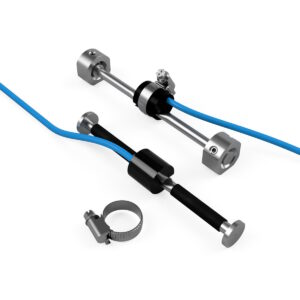
The Electric Crackmeter uses a potentiometric displacement transducer to detect changes in position between two points located near a joint or injury.
Wire displacement sensors detect ground movement in unstable areas, offering reliable geotechnical monitoring in high-risk environments.
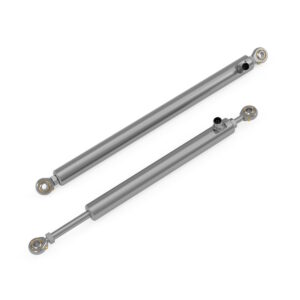
The displacement transducers are commonly used to run on automatically and continuously the measurements of borehole rod extensometers. It is necessary to install one displacement transducer for each point of measure in order to transform the mechanical movement of the rod into an electrical signal.